











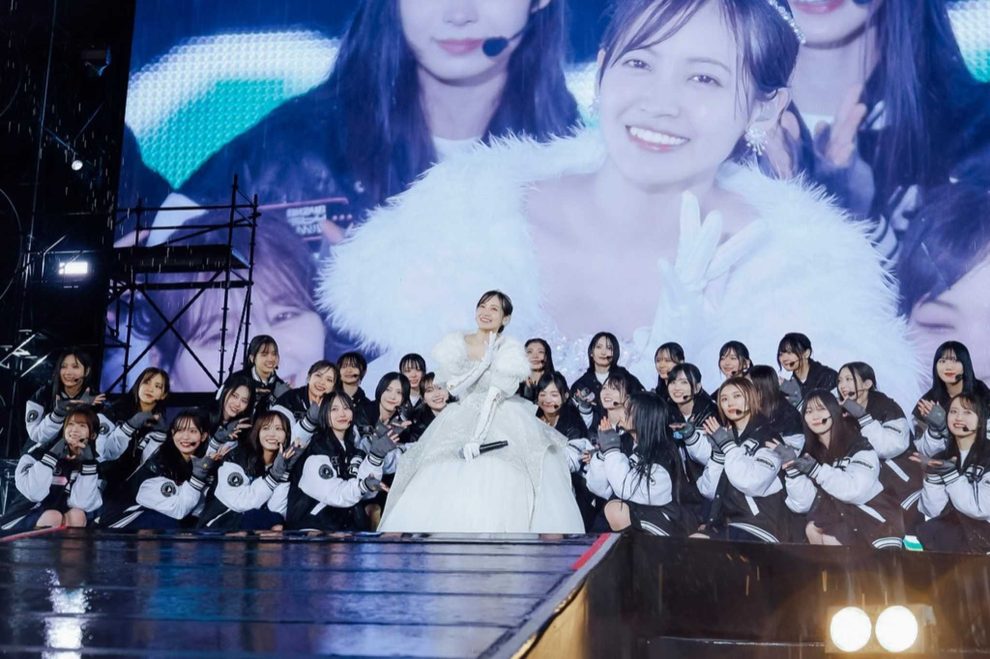

This November, Sakurazaka46 closed out another era with the graduation of their second captain Rina Matsuda. After joining as part of the idol group’s second generation in 2018, she was given the position from Yuuka Sugai in November 2022. “After releasing our first album, we felt more confident in delivering what makes us Sakurazaka,” the group’s Ten Yamasaki once said. If Sugai’s leadership helped the group form a stronger sense of identity, Matsuda steered the ship toward bigger avenues.
From 2023 on, Sakuarazaka honed their skills as a performance act. The group cultivated more and more anthems built to captivate a live audience while growing the size of their crowd. “We got to fill up venues like Tokyo Dome and Zozo Marine Stadium with our fans, all 360 degrees,” second-gen member Hono Tamura once said about their 2024. “We got to feel firsthand that more and more people are hearing about our shows.” They played larger venues but also began to expand their reach, performing at music festivals, both domestic and overseas.
With Matsuda’s departure, and more imminent graduations of the second generation, the coming years soon will look to be a changing of the guard for the group. But if her graduation ceremony was any indication, she leaves behind two strong generations of members who are ready to follow her lead and build upon her legacy. The Rina Matsuda era of Sakurazaka, 2023 – 2026, observed important milestones for the group. We look back at the years through 8 essential tracks from the period.
“Ikutsu No Koro Ni Modoritainoka?” (2024)
Looking back, Sakurazaka practically willed the attitudes expressed in “Ikutsu No Koro Ni Modoritainoka?” into existence during the Matsuda years. “I know I can’t go back to the past / if I’m going to dream, I want it to be about the future,” they sang here, and as if to keep their word, the group constantly strived to reach the yet unseen: new stages, new audiences, new opportunities. They also invested a lot more in their new generation, who barely hit a year with the group at the time of this single’s release: with the third line began Shinzanmono, a concert series spotlighting the new Sakamichi gens, where the fresh additions of each of the three groups hosted their own show.
While a resistance against nostalgia may hint at their Keyakizaka roots, Sakurazaka sounds far more optimistic about their own future in “Ikutsu No Koro…” than they ever have in their past iteration. Maybe it’s the rock music itching to get a move on, maybe it’s the ever-happy-go-lucky Ten Yamazaki taking center position, but the group here seems thrilled to face the unknowny: “Right now, I don’t care / about the destination.” Before they even stood on those bigger stages and won those bigger crowds, “Ikutsu No Koro…” teased a brighter outlook for a new era.
See also: “The growing up train” (2026)
“Shoninyokkyu” (2023)
Sakurazaka had been investing in stage theatrics since their rebrand, but this spartan dance number was their biggest yet in scale. The EDM production is huge from the intro on, blasting punishing synths and deafening bass. The idols meanwhile appear militant as they move in formation to the blown-out beat without a crack in their expression. With countless flashing screens fighting for attention in sync to the siren raid of background music, it’s nearly sensory overload when performed live. “Shoninyokkyu” became their calling card for their shows, saved toward the end as a set-closer, and soon a must-play for their appearances at rock festivals. As their stages got bigger, and their reputation as live act grew, they tweaked their performance to bring more and more firepower.
See also: “Start over!” (2023); “Lonesome rabbit” (2026)
“Natsu No Chikamichi” (2023)
Not long after Matsuda took leadership, Sakurazaka gained its third wave of members, a crew of extroverted personalities who shared a tight-knit camaraderie. Their arrival also opened the possibility for new attitudes in the group’s music, and “Natsu No Chikamichi” thrived upon a youthful innocence unique to the group’s fresh generation.
While Sakurazaka have been cynics about love in their past singles, “Natsu No Chikamichi” finds the third gen fully consumed by the thoughts about their schoolground love. All they can focus on is how to close the gap between them and their crush before someone else gets to it first. Time never seems to be on their side, and the breezy music telegraphs that clock-ticking anxiety as much as the overall fluttering of their heart. Later songs revealed more facets of the third gen, yet “Natsu No Chikamichi” captured a preciousness only afforded to those just starting out.
See also: “Nando LOVE SONG No Kashi Wo Yomikaeshitadaro” (2024); “Nightmare Shokougun” (2025)
“Abura Wo Sase!” (2024)
BACKS LIVE!!— a concert series led by members not part of the main line-up behind a given single — developed into a legit franchise during the Matsuda era, which was not an easy feat especially in its early years. Working with a set list consisting of no main singles, the BACKS line-up had to let lesser-known B-sides really sing through their performance. Even as they accumulated more songs written for them, it still depended on their skills to elevate the songs into anthems. So it’s proof to their success that “Abura Wo Sase!,” one of the first BACKS songs, grew from a deep cut into a live-show staple that stands as canonical as their mainline singles.
Much of the success is owed to Yui Takemoto, the member manning the center position for the song. From its brassy arrangement to its declarative hook, “Abura Wo Sase!” is designed to highlight her strength as a star performer. She leaves a stunning impression as its central presence without having to lift a finger. Fans already know what’s in stores seeing her seated with no bother in the world as the intro blares behind her, and it’s this precise aura that other members aim to replicate after her departure. More key tracks have emerged since, but “Abura Wo Sase!” was the one that first demanded for BACKS to be taken more seriously.
See also: “Minatoku Parsley” (2025); “I will be” (2025)
“Jigoujitoku” (2024)
Shizuki Yamashita had big shoes to fill when she was chosen as the center position behind “Jigoujitoku.” This was the first time for the younger third generation to lead a single. The single also simply demanded a lot in terms of its central presence to match the intensity behind the production, like a “Shoninyokkyu,” part two. But Yamashita faced the challenging music without a flinch. She may appear small, yet the more aggressive the music grows, she transforms into a whole different beast: check her rile up the crowd whenever the group performs the industrial-metal rave-up “Mouikkyoku Hoshiinoka?” — you want one more song? — where she lets out a piercing scream for more from the audience. Yamashita’s other peers followed her path to the center place in the years since. “Jigoujitoku” was when the group’s new wave first assured that they could very well rise to the occasion.
See also: “Make or Break” (2025); “Unhappy Birthday Koubun” (2025)
“Pikkaan!” [Giga & Teddyloid meets Rina Matsuda & Hikaru Morita] (2024)
“Pikkaan!” figures into the Sakurazaka catalog more as a side quest but this detour is nevertheless an important one. Pokemon tapped Matsuda and fellow second-gen Hikaru Morita to sing the title song of their anime. The two singing on a production from an outside name is enough of a novelty, though it’s also not like they haven’t dealt with this kind of noisy, gurgling electropop for their own records. Yet this anime tie-in also got their foot in a whole different door. While Sakurazaka had already been attracting attention overseas from their East and Southeast Asian neighbors as a live act, “Pikkaan!” gave an extra push for them to perform in America for the first time. They landed on new, foreign stages, but they were more than ready to wow these new crowds after years spent sharpening their craft.
See also: “What’s KAZOKU?” (2026)
“Shindafuri” (2025)
The Rina Matsuda era also welcomed a fourth wave of new members. While they were embraced warmly by members before them, these were also a set of determined idols striving to live up to the Sakurazaka name without relying fully on the work by their predecessors. Their debut song, “Shindafuri,” spelled out their aspirations to strike it out on their own from the jump. “Being told to play dead / what are we even living for,” this young wave asks themselves in a self-critical manner echoing the group’s early days, but not before channeling all this frustration as fuel to forge a new path: “conviction / is the burning energy to life.” The fourth gen have since grown more into their own, living up to the ambitions of their debut song.
See also: “Kougen” (2026); “We got your back” (2026)
“Aozora Ga Mierumade” (2025)
Despite their indifference toward nostalgia in their music, the group’s fifth anniversary concert at the MUFG Stadium — their biggest venue yet — celebrated how far the group has come since re-introducing themselves as Sakurazaka. A point of pride in particular was nurturing a hopeful next generation, expressed best with their first single, “Nobody’s fault,” revisited now with dozens of new members who have since joined the cause. But seeing the growth of their family tree served as strong of a reminder of how integral the second gen, Matsuda and her peers, have been to the entire project.
“Until we see the blue sky, we will become the wind,” the second gen sing the titular chorus of “Aozora Ga Mierumade,” one of the few songs written exclusively for them. “Even if it rains, we won’t give up.” They’ve weathered the storms since the beginning, facing identity crises and unfilled venues; they had to rise up to help carry the group especially as their predecessors began to graduate. If there was any uncertainty befalling Matsuda when she took on the group from Yuuka Sugai’s stewardship, all she had to do at that moment at MUFG was look at where she was able to take the group together with her fellow second gen.
See also: “Mamoribito” (2023); “Monshirocho Ga Tashika Tondeta” (2025)


